Liked, Shared, Never Worn: What Purchase Records Reveal About America's Sustainable Fashion Façade
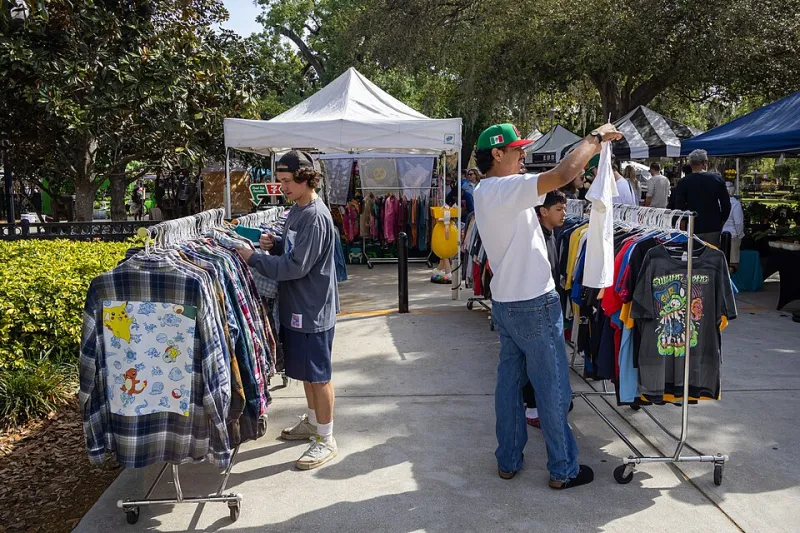
Photo: Nielsoncaetanosalmeron, CC BY 4.0, via Wikimedia Commons
Scroll through any major social media platform and the narrative seems clear: American consumers are demanding sustainable fashion, holding fast-fashion brands accountable, and willing to pay more for clothing that reflects their values. The hashtags rack up millions of impressions. Ethical brand campaigns generate engagement rates that traditional retailers can only envy. Yet when researchers cross-reference that digital enthusiasm with actual transaction records, the picture that emerges is considerably more complicated — and far more instructive for brands trying to build viable business models around eco-conscious consumers.
The US apparel market generates roughly $350 billion in annual revenue. Sustainable and ethically produced clothing accounts for an estimated $47 billion of that figure — a number that sounds substantial until you consider that fast-fashion platforms, led by ultra-low-cost operators that have aggressively expanded their American customer base, grew their collective US transaction volume by double digits in each of the past three years. The consumers driving both trends are, in many cases, the same people.
The Engagement-to-Transaction Chasm
Consumer survey data collected across multiple research cycles consistently shows that between 65 and 72 percent of American adults describe environmental impact as either "important" or "very important" when making clothing purchases. Roughly 58 percent report actively seeking out sustainable brands when shopping for apparel. These are not marginal figures. They suggest a marketplace primed for ethical consumption at scale.
Transaction data disagrees. When purchase records are analyzed alongside survey responses from the same respondents — a methodology that eliminates the distortion created by self-reporting bias — the share of clothing spend actually directed toward certified sustainable or ethically produced garments drops to between 11 and 17 percent, depending on the income bracket and geographic region examined. The remainder flows toward conventional fast-fashion retailers, mass-market department stores, and the growing ecosystem of ultra-cheap direct-from-manufacturer platforms.
The divergence is not simply a matter of consumers lying to researchers. Behavioral economists describe the phenomenon as an intention-action gap — the measurable distance between what people genuinely believe they will do and what they actually do when confronted with a purchase decision. In the apparel category, that gap is among the widest observed across any consumer goods segment.
Where the Price Tolerance Breaks Down
Perhaps the most commercially actionable finding from purchase-behavior research concerns the specific price thresholds at which stated environmental values begin to yield to cost sensitivity. Survey respondents routinely claim willingness to pay a premium for sustainable clothing, with median self-reported tolerance for that premium falling between 15 and 25 percent above conventional retail pricing.
Actual transaction data places the real tolerance threshold considerably lower. For everyday apparel categories — t-shirts, casual trousers, basic knitwear — purchase probability for the sustainable option begins declining sharply once the price premium exceeds approximately 8 to 12 percent. For footwear, the threshold is slightly more generous, with consumers demonstrating willingness to absorb premiums of up to 18 percent before abandoning the ethical option at checkout. Outerwear and occasion-wear categories show the greatest alignment between stated and actual premium tolerance, likely because these items carry inherently higher price points and longer expected use cycles that make per-wear cost calculations more favorable.
The implication for sustainable fashion brands is significant. Pricing strategy built on survey-derived willingness-to-pay data may be systematically overestimating the addressable market by a factor of two or more.
Demographic Segments With the Smallest Gaps
Not all consumer segments perform equally poorly against their stated intentions. Research isolating specific demographic cohorts reveals meaningful variation in the size of the intention-action gap — variation that carries direct implications for targeting and product development.
Higher-income households — specifically those with annual household income exceeding $150,000 — demonstrate the closest alignment between expressed values and actual purchase behavior in the sustainable apparel category. Within this segment, the share of clothing spend directed toward sustainable brands rises to approximately 28 to 34 percent, compared to the 11 to 17 percent average observed across the broader population. This alignment is not primarily ideological; it is structural. At this income level, the price premium associated with ethical production represents a smaller fraction of discretionary spending, effectively removing the friction that causes lower-income consumers to abandon their stated preferences at the point of purchase.
Millennial women between the ages of 28 and 42 represent another segment where the gap narrows, though the dynamic differs from the income-driven pattern. Research indicates this cohort engages in more deliberate pre-purchase research, is more likely to consult third-party certification databases, and demonstrates higher rates of wardrobe curation behavior — buying fewer items at higher price points rather than purchasing volume at lower ones. Their actual sustainable spend share runs approximately 22 to 26 percent, meaningfully above the population average.
By contrast, Gen Z consumers — despite generating the highest volume of sustainable fashion content on social platforms — show some of the widest intention-action gaps in the dataset. Transaction records indicate that this age group directs a disproportionate share of its apparel spend toward ultra-low-cost platforms, a pattern that researchers attribute to constrained discretionary budgets rather than indifference to environmental concerns.
The Role of Convenience Architecture
Transaction data also surfaces a variable that survey instruments rarely capture effectively: the role of purchase convenience in determining which values ultimately prevail at checkout. Sustainable fashion brands that have invested in streamlined digital commerce infrastructure — fast-loading mobile experiences, simplified return policies, and transparent sizing tools — show meaningfully higher conversion rates among environmentally motivated consumers than brands offering equivalent product quality through friction-heavy purchase journeys.
This finding suggests that a portion of the intention-action gap in sustainable apparel is not driven by price sensitivity or insufficient commitment to stated values, but by the relative ease of completing a fast-fashion transaction compared to a sustainable one. Fast-fashion platforms have invested heavily in reducing purchase friction to near zero. Many sustainable brands have not matched that investment, inadvertently creating a structural disadvantage that compounds the price premium challenge.
What the Data Demands of Retailers
For brands operating in the sustainable apparel space, the aggregate picture from purchase behavior research argues against strategies built primarily on converting the environmentally vocal consumer. That consumer exists, spends meaningfully, and is reachable — but the segment is considerably smaller than social engagement metrics imply.
A more durable growth strategy, supported by transaction data, involves identifying the structural conditions under which stated values translate into actual purchases: price premiums held below demonstrated tolerance thresholds, purchase journeys designed to minimize friction, and product positioning that connects environmental value to durability and cost-per-wear rather than abstract ethical commitments.
For conventional retailers, the data carries a different but equally clear message. The consumers filling fast-fashion shopping carts are not indifferent to sustainability; many are genuinely conflicted. Brands that acknowledge that conflict honestly — rather than dismissing it or exploiting it — are better positioned to build the kind of durable consumer relationships that transaction records, over time, will eventually validate.